By XH-Alan | 31 March 2026 | 906 Views
Li-ion vs Li-polymer Batteries: Full Comparison & 2026 Selection Guide
Choosing the optimal rechargeable battery chemistry is critical to maximizing device performance, safety, and service life across consumer electronics, industrial tools, and specialty applications. For product designers, engineers, and end-users across North America and Europe, understanding the core differences between lithium-ion (Li-ion) and lithium-polymer (Li-po) batteries is the foundation of making an informed, cost-effective power solution choice. This guide breaks down their fundamental chemistry, real-world performance, safety profiles, and ideal use cases to simplify your selection process.
Core Fundamentals of Lithium-Ion (Li-ion) Batteries
Lithium-ion batteries are mature, mass-produced rechargeable cells that use a liquid organic electrolyte to facilitate lithium ion transfer between the cathode and anode during charge and discharge cycles. Standard cell construction includes a lithium-based cathode (typically LCO, NMC, or LFP formulations), a graphite-based carbon anode, a polyolefin separator, and a liquid electrolyte housed in a rigid steel or aluminum cylindrical/prismatic casing. Renowned for stable high energy density and long cycle life, Li-ion cells are the global standard for high-power, long-service-life applications.
What Are Lithium-Polymer (Li-po) Batteries?
Lithium-polymer batteries use a gel-like or solid polymer electrolyte in place of a liquid formulation, paired with a flexible aluminum-laminate pouch casing instead of a rigid hard shell. This construction enables ultra-thin, customizable, and flexible form factors that cannot be achieved with standard Li-ion cells, alongside a lower risk of electrolyte leakage. Li-po cells are optimized for compact, space-constrained electronics where form factor is a top priority.
Head-to-Head Technical & Performance Comparison
| Core Feature | Lithium-Ion (Li-ion) | Lithium-Polymer (Li-po) |
|---|---|---|
| Electrolyte Type | Liquid organic electrolyte | Gel/solid polymer electrolyte |
| Casing Structure | Rigid steel/aluminum cylindrical/prismatic | Flexible aluminum-laminate pouch |
| Energy Density | 150–250 Wh/kg (up to 300 Wh/kg for premium automotive cells) | 130–265 Wh/kg |
| Rated Cycle Life | 500–1200 full cycles (premium LFP cells up to 6000+) | 300–500 full cycles |
| Relative Cost | Lower (mature high-volume manufacturing) | Higher (custom form factor production) |
Safety, Lifespan & Real-World Performance Breakdown
Cycle Life & Long-Term Durability
Li-ion cells deliver significantly longer service life, as their liquid electrolyte maintains more consistent ion conductivity over repeated charge cycles, while the gel electrolyte in Li-po cells degrades faster with regular use. For applications requiring multi-year reliable performance, Li-ion is the clear preferred choice.
Safety Profile
Both chemistries rely on integrated battery management systems (BMS) to prevent overcharging, overheating, and short circuits. Li-ion’s rigid casing provides superior physical impact protection, while its liquid electrolyte carries a minor risk of leakage in the event of casing damage. Li-po’s gel electrolyte and flexible pouch design nearly eliminate leakage risk, with damage typically resulting in mild swelling rather than thermal runaway, making it ideal for portable, body-worn electronics.
Charging & Power Delivery
Li-po cells support faster rapid charging rates thanks to the improved thermal stability of their polymer electrolyte, while Li-ion cells deliver more consistent high-discharge performance for power-intensive applications like electric tools and vehicles.
Cost Analysis & Ideal Use Cases
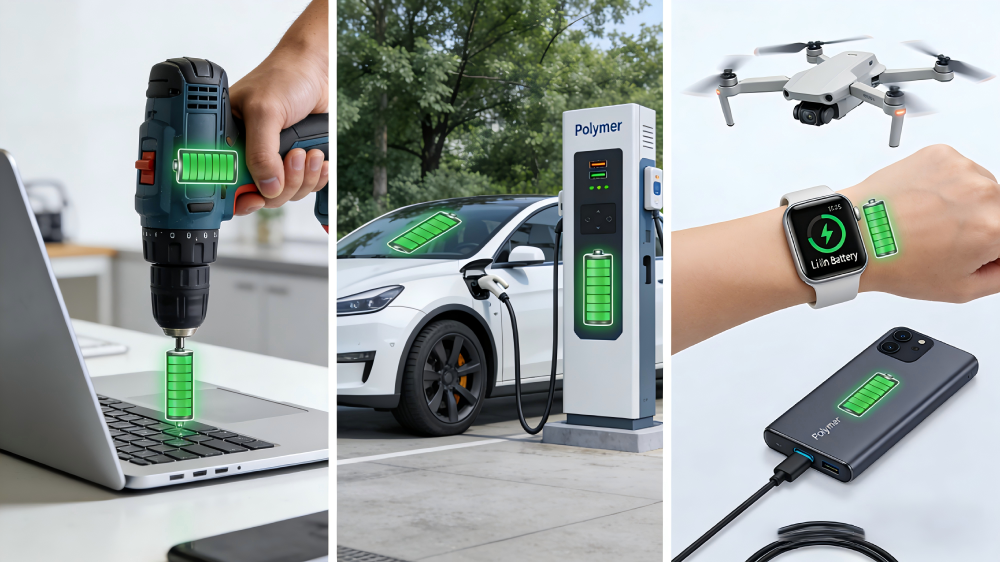
Li-ion batteries benefit from decades of scaled manufacturing, delivering unmatched cost efficiency for high-volume applications. They are the optimal choice for smartphones, laptops, electric vehicles, power tools, and stationary energy storage systems.
Li-po batteries carry a higher per-kWh cost, but offer unrivaled design flexibility. They are the preferred solution for drones, smart wearables, RC hobby devices, ultra-thin portable electronics, and flexible custom-form-factor devices.
How to Select the Right Chemistry
Choose Li-ion if your priority is long cycle life, low cost, consistent high-power output, and proven long-term reliability. Choose Li-po if you require custom ultra-thin/flexible form factors, lightweight construction, and minimal leakage risk for compact portable devices.
Pro Maintenance Tips to Maximize Battery Lifespan
- Stick to a 20%–80% state of charge (SOC) window for routine charging, avoiding full 0%–100% cycles
- Only use certified chargers matched to your battery’s voltage and current specifications
- For long-term storage, maintain 40%–50% SOC in a cool, dry environment (15–25°C)
- Cycle idle batteries every 3–6 months to prevent permanent capacity fade
- Replace aging batteries immediately if you notice swelling, overheating, or severe runtime reduction
Final Takeaways
Li-ion batteries deliver unmatched cost efficiency, long cycle life, and consistent high-power performance for mainstream and industrial applications, while Li-po batteries excel in custom form factor design, ultra-slim profiles, and lightweight portability for specialty electronics. The right choice ultimately depends on your device’s form factor, performance requirements, budget, and end-use environment. XIHO Battery designs and manufactures custom Li-ion and Li-po battery solutions tailored to the unique needs of North American and European product designers, industrial manufacturers, and electronics brands, delivering safety-certified, high-performance power systems for every application.
Welcome to contact us:
Inquiry more product details from the : Lithium Ion Battery Manufacturers
WhatsApp/Wechat/Mobile: +86 13332949210
Email: info@xihobattery.com
Welcome to contact us:
Inquiry more product details from the : Lithium Ion Battery Manufacturers
WhatsApp/Wechat/Mobile: +86 13332949210
Email: info@xihobattery.com
LiFePO4 Batteries for Solar Energy Storage: Complete 2026 Performance Guide
3.7V Lithium-Ion Batteries: Lifespan Guide & Optimization Best Practices
Leave a Reply
Your email address will not be published.Required fields are marked. *