By XH-Alan | 20 April 2026 | 379 Views
What Is a BMS Battery? Complete Guide to Battery Management Systems 2026
A Battery Management System (BMS) is the unsung backbone of modern lithium battery technology, serving as the electronic brain that ensures safety, optimizes performance, and extends battery lifespan across every application. From electric vehicles and solar energy storage systems to portable medical devices and industrial equipment, BMS technology is non-negotiable for reliable, long-lasting energy solutions. This comprehensive guide breaks down everything you need to know about BMS systems, their core functions, and why they are critical for any lithium battery deployment.
What Exactly Is a Battery Management System?
A BMS is an advanced electronic control system that monitors, regulates, and protects rechargeable battery packs, particularly those composed of multiple individual cells. It continuously tracks critical parameters including cell voltage, pack current, temperature, and state of charge (SoC), ensuring the battery operates within predefined safe limits at all times. While single-cell lithium batteries may use basic protection circuits, any multi-cell system requires a full BMS to prevent catastrophic failure and maximize performance.
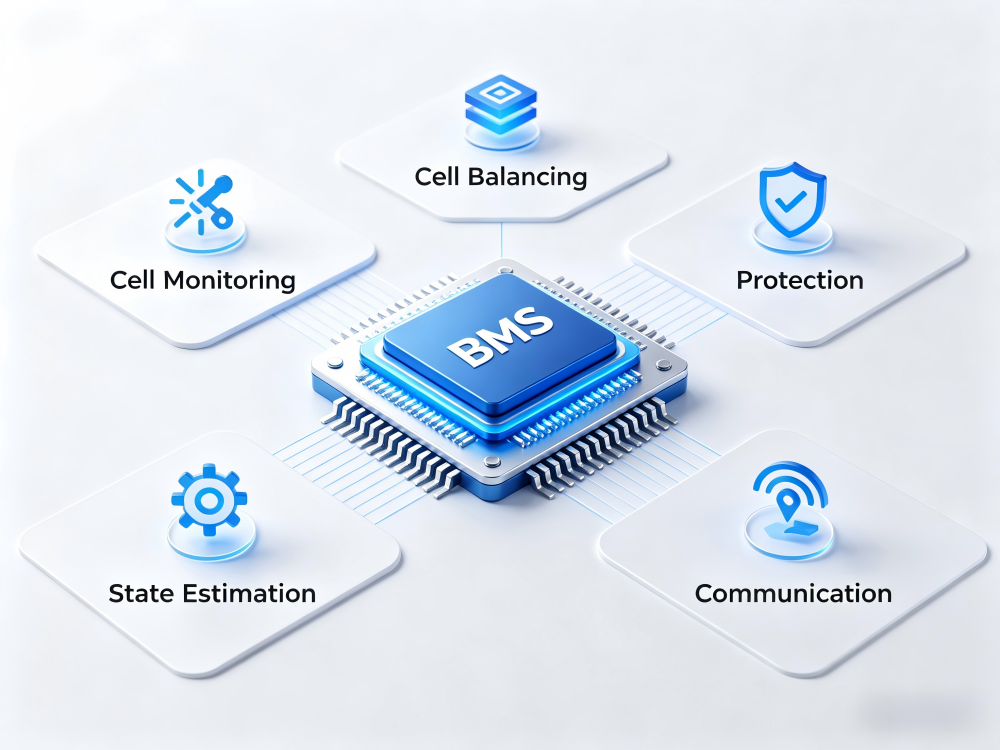
Five Core Functions of a Modern BMS
The value of a BMS lies in its ability to perform multiple critical tasks simultaneously:
- Real-Time Cell Monitoring: The BMS tracks voltage and temperature for every individual cell in the pack, detecting imbalances and potential failures before they become safety hazards.
- Intelligent Cell Balancing: It ensures all cells charge and discharge evenly, maximizing usable capacity and preventing premature degradation of weaker cells.
- Multi-Layer Protection: The system provides robust protection against overcharging, over-discharging, overheating, short circuits, and overcurrent, eliminating the risk of thermal runaway.
- Accurate State Estimation: Advanced algorithms calculate remaining capacity (SoC), state of health (SoH), and remaining useful life, enabling precise energy management.
- Seamless Communication: Modern BMS units communicate with external systems via CAN bus, Bluetooth, or UART, providing remote monitoring, diagnostics, and integration with larger energy management systems.
Why a BMS Is Non-Negotiable for Lithium Batteries
Without a properly functioning BMS, lithium batteries pose significant safety risks including fires and explosions. Beyond safety, a BMS extends battery lifespan by up to 300% by maintaining optimal operating conditions, improves overall system performance through balanced energy distribution, and prevents costly damage from deep discharge or overvoltage events. A single BMS typically manages an entire battery pack, though each independent pack in a multi-pack system requires its own dedicated BMS for proper protection.
Common BMS Questions Answered
Many users confuse BMS with basic battery controllers, but the two are not interchangeable: a battery controller typically handles only charging or discharging functions, while a BMS provides comprehensive monitoring, protection, and balancing. While most BMS systems use electronic MOSFET protection rather than physical fuses, both are often used together for maximum safety. Charging a lithium battery without a BMS is extremely dangerous, as individual cell voltages and temperatures go unmonitored, dramatically increasing failure risk.
How to Choose and Maintain Your BMS
When selecting a BMS, first match it to your battery’s cell configuration (e.g., 4S, 16S), voltage rating, and current capacity. Ensure it is compatible with your specific battery chemistry (LFP, NMC, etc.) and consider additional features like Bluetooth connectivity or CAN bus integration for advanced monitoring. To maintain optimal performance, regularly check individual cell voltages, test protection features periodically, and keep BMS firmware updated using manufacturer software. If a BMS enters sleep mode, reactivate it by applying a small external voltage or using a compatible charger. Most BMS systems can be reset by disconnecting all connections, waiting 30 seconds, and reconnecting the charger.
Final Takeaway
A reliable Battery Management System is the foundation of any safe, high-performance lithium battery system. It protects against catastrophic failure, maximizes energy efficiency, and extends battery lifespan, delivering significant long-term cost savings. Whether you are designing an electric vehicle, a solar storage system, or a portable industrial device, investing in a high-quality BMS is one of the most critical decisions you can make for the success and safety of your project.
Welcome to contact us:
Inquiry more product details from the : Lithium Ion Battery Manufacturers
WhatsApp/Wechat/Mobile: +86 13332949210
Email: info@xihobattery.com
Website: www.xihobattery.com
Welcome to contact us:
Inquiry more product details from the : Lithium Ion Battery Manufacturers
WhatsApp/Wechat/Mobile: +86 13332949210
Email: info@xihobattery.com
Website: www.xihobattery.com
What Type of Battery Does a Lawn Mower Use? Complete 2026 Guide to Lawn Mower Batteries
Lithium Battery Cell Manufacturing Process: A Comprehensive Step-by-Step Guide
Leave a Reply
Your email address will not be published.Required fields are marked. *