How to Choose the Perfect Lithium-Ion Battery Cell: Expert Selection Guide 2026
Selecting the right lithium-ion battery cell is far more than a technical detail—it is the foundation of your product’s performance, safety, and long-term commercial success. Whether designing consumer electronics, electric vehicles, or industrial systems, the battery cell acts as the core energy engine, directly impacting user experience, maintenance costs, and regulatory compliance. This expert guide breaks down the step-by-step process to make informed, data-driven battery selection decisions.
Lithium-Ion Battery Fundamentals
Lithium-ion batteries dominate modern energy storage due to their exceptional energy density, typically ranging from 240 to 270 Wh/kg, making them ideal for compact and portable applications. For projects prioritizing safety and longevity, lithium iron phosphate (LiFePO4) batteries offer enhanced thermal stability and cycle life exceeding 1,000 full charge-discharge cycles. Understanding these core chemistry differences is the first critical step in the selection process.
Step 1: Define Your Application Requirements First
Before evaluating any cell, clearly document your system’s non-negotiable requirements, including operating voltage, continuous and peak current, required runtime, environmental conditions, and physical size constraints. Different applications demand different trade-offs:
-
Consumer electronics: Prioritize high energy density and compact form factors
-
Power tools and electric vehicles: Require high discharge rates and robust thermal performance
-
Medical devices: Emphasize absolute safety, reliability, and long cycle life
Step 2: Evaluate Physical and Environmental Constraints
Battery design must align with available space and operating conditions. The three primary form factors each have distinct advantages:
-
Pouch cells: Flexible and lightweight, ideal for ultra-thin devices and custom shapes
-
Prismatic cells: Efficient space utilization and high capacity, perfect for large-scale energy systems
-
Cylindrical cells: Standardized, durable, and cost-effective, excellent for high-power applications
Step 3: Calculate Accurate Power and Energy Needs
Use these fundamental formulas to determine your required battery capacity:
-
Amp-hours (Ah) = Continuous Current × Required Runtime
-
Watt-hours (Wh) = Nominal Voltage × Amp-hours
Always account for peak load demands and temperature effects on capacity, as performance drops significantly outside the optimal 25°C to 40°C operating range.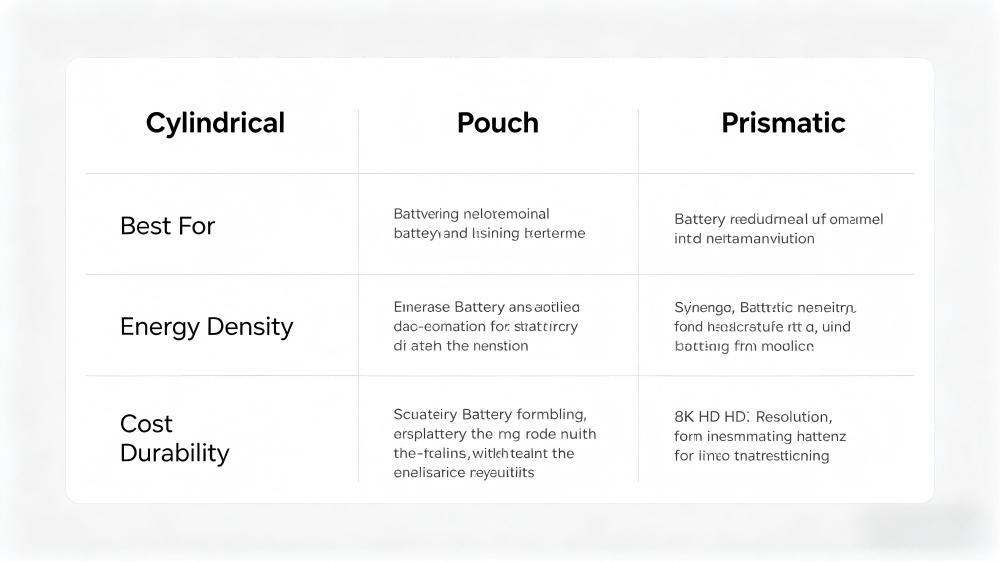
Step 4: Assess Critical Performance Metrics
Evaluate these key metrics to compare different cell options:
-
Energy Density: Measured in Wh/kg (gravimetric) and Wh/L (volumetric), determines weight and space efficiency
-
Discharge Rate (C-Rate): Indicates how fast a battery can deliver power relative to its capacity
-
Thermal Performance: Critical for preventing overheating and ensuring safety under load
-
Cycle Life: Defines how many charge cycles a battery can complete before degrading to 80% of its original capacity
Step 5: Integration, Sourcing and Compliance
Decide between removable and embedded battery designs based on your product’s use case. When sourcing cells, select manufacturers with proven quality control, industry certifications, and stable supply chains. Essential certifications include UN 38.3 (transportation), UL 1642 (cell safety), IEC 62133 (international safety), and CE marking (European compliance). Also consider ethical sourcing practices and end-of-life recycling programs to mitigate long-term risks.
Best Practices and Key Takeaways
Follow these best practices for optimal results: define requirements before evaluating options, select the appropriate form factor for your application, prioritize safety and thermal management above all else, validate performance through rigorous testing, and plan for long-term component availability. The right lithium-ion battery cell will deliver consistent performance, ensure user safety, and maximize your product’s lifespan and value.
Welcome to contact us:
Inquiry more product details from the : Lithium Ion Battery Manufacturers
WhatsApp/Wechat/Mobile: +86 13332949210
Email: info@xihobattery.com
Website: www.xihobattery.com