By XH-Alan | 26 March 2026 | 188 Views
Critical Backup Lithium Batteries for Healthcare: 5S1P vs 7S1P Power Systems
In modern healthcare settings, uninterrupted power is a life-critical necessity. Emergency backup lithium batteries, particularly medical-grade LiFePO4 systems, are the cornerstone of care continuity, ensuring life-sustaining medical devices remain fully operational during grid outages. These advanced energy storage solutions have widely displaced legacy lead-acid technologies across North American and European healthcare networks, thanks to their superior efficiency, extended service life, and inherent safety for clinical environments.
Why Uninterrupted Power Is Non-Negotiable for Healthcare Facilities
Hospitals and clinics depend on consistent power to maintain full-spectrum patient care. Reliable backup lithium batteries eliminate downtime for critical assets including operating room surgical suites, ICU life-support equipment, emergency egress lighting, respiratory ventilators, defibrillators, patient monitoring devices, and remote telehealth systems. LiFePO4 chemistries are the industry standard for these applications, delivering high energy density, consistent voltage output, and long service life to meet the rigorous demands of 24/7 clinical operations.
Catastrophic Risks of Unplanned Healthcare Power Outages
Even brief grid failures can have devastating consequences in clinical settings. Without a robust backup power system, facilities face total failure of life-sustaining equipment, interrupted high-risk surgical procedures, loss of access to critical electronic health records, and overwhelming strain on emergency response teams. These risks make selecting a compliant, reliable battery system a top patient safety priority for healthcare administrators.
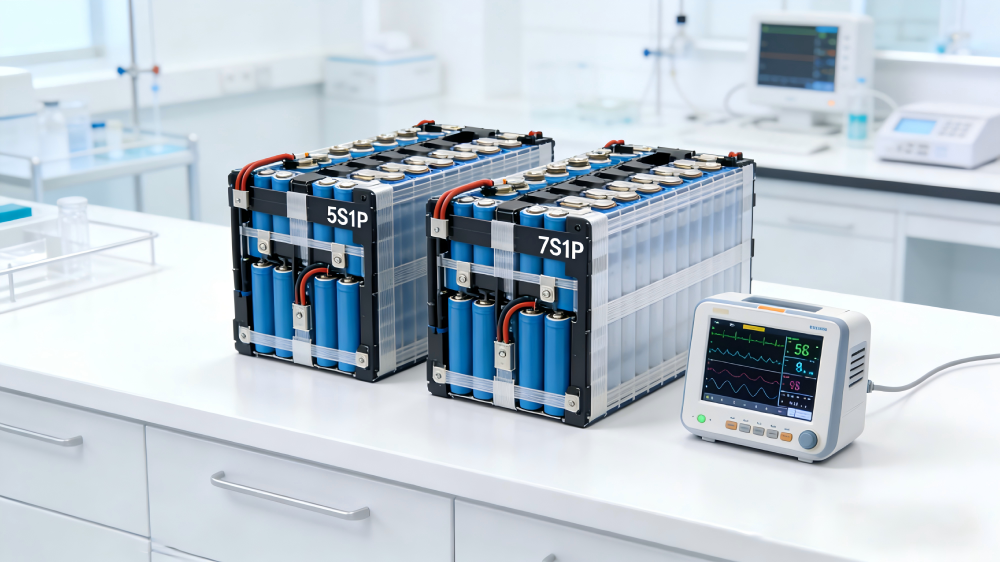
5S1P vs 7S1P: Medical-Grade Battery Configurations Explained
Battery pack configuration defines how cells are arranged to deliver targeted voltage and capacity for specific medical devices:
- 5S1P: 5 lithium cells wired in series, delivering a ~16V nominal output with 1500mAh capacity, optimized for moderate-power clinical devices.
- 7S1P: 7 lithium cells wired in series, delivering a ~22.4V nominal output with matching 1500mAh capacity, engineered for high-performance medical equipment requiring elevated voltage. The core performance distinction lies in voltage output: 7S1P packs serve power-intensive clinical systems, while 5S1P configurations fit lower-to-moderate power devices needing consistent long-duration runtime.
Intelligent BMS: The Backbone of Safe Medical Battery Performance
Modern medical-grade battery packs rely on advanced Battery Management Systems (BMS) to guarantee safety and reliability in clinical settings. These integrated modules continuously monitor cell voltage, charge/discharge current, ambient and internal temperature, state of charge (SOC), and long-term battery health (SOH). Key benefits include predictive maintenance alerts, real-time performance tracking, and overcharge/over-discharge protection, ensuring uninterrupted operation during critical care scenarios.
Global Regulatory Compliance for Medical Backup Batteries
Healthcare battery systems must meet strict international safety regulations for use in North American and European clinical settings. Mandatory standards include IEC 62133 (lithium battery safety requirements), IEC 60086-4 (electromechanical safety for portable batteries), UL 1642 (lithium battery safety certification), and ANSI/AAMI ES 60601-1 (medical electrical equipment safety standards). Full compliance mitigates clinical risk and aligns with hospital accreditation requirements.
Stable Performance Across Variable Clinical Environments
Medical-grade LiFePO4 backup batteries deliver consistent performance across a -20°C to 70°C operating range, maintaining full capacity and efficiency even in variable clinical settings. This outperforms legacy lead-acid batteries, which suffer significant capacity loss in extreme temperatures common in hospital supply closets, ambulance bays, and remote clinical sites.
Core Advantages of Lithium Over Legacy Lead-Acid Systems
Lithium backup batteries deliver transformative benefits for healthcare facilities: unmatched reliability, high energy density for extended outage runtime, ultra-low self-discharge rates, and a service life 3x longer than lead-acid alternatives. Unlike lead-acid batteries requiring quarterly maintenance (fluid refills, terminal cleaning, equalization charges), lithium systems only need annual visual inspections, reducing facility workload and operational downtime.
Evolving Trends in Medical Backup Power Technology
The future of healthcare backup batteries centers on higher energy density for compact, space-saving packs, extended cycle life for lower total cost of ownership, AI-integrated smart monitoring for predictive maintenance, and modular scalable designs to fit diverse medical device requirements.
Final Thoughts
Emergency backup lithium batteries are an irreplaceable component of modern healthcare infrastructure. With tailored 5S1P and 7S1P configurations, intelligent BMS technology, and full compliance with global medical safety standards, these power solutions deliver the reliability and safety required to protect patient lives. As a leading provider of medical-grade LiFePO4 battery systems for North American and European healthcare facilities, XIHO Battery designs custom, compliant backup power solutions to meet unique clinical needs. For product inquiries, contact our team via email at info@xihobattery.com, phone/WhatsApp at +86 13332949210, or visit www.xihobattery.com.
Welcome to contact us:
Inquiry more product details from the : Lithium Ion Battery Manufacturers
WhatsApp/Wechat/Mobile: +86 13332949210
Email: info@xihobattery.com
Website: www.xihobattery.com
Welcome to contact us:
Inquiry more product details from the : Lithium Ion Battery Manufacturers
WhatsApp/Wechat/Mobile: +86 13332949210
Email: info@xihobattery.com
Website: www.xihobattery.com
3.7V Lithium-Ion Batteries: Lifespan Guide & Optimization Best Practices
LiFePO4 Forklift Batteries: Transformative Upgrade for Material Handling Operations
Leave a Reply
Your email address will not be published.Required fields are marked. *