By XH-Alan | 12 March 2026 | 78 Views
Zero-Emission Sailing Handbook: Build a 48kWh High-Voltage LiFePO4 Battery System for Electric Sailb
Zero-Emission Sailing Handbook: Build a 48kWh High-Voltage LiFePO4 Battery System for Electric Sailboat Conversions
As eco-conscious sailing surges in popularity, more cruising enthusiasts are prioritizing reliable, high-performance battery systems for their electric sailboat retrofits. Swapping a loud, fume-heavy diesel engine for a smooth, silent electric propulsion system doesn’t just elevate your on-water experience—it delivers fully zero-emission navigation aligned with sustainable marine practices.
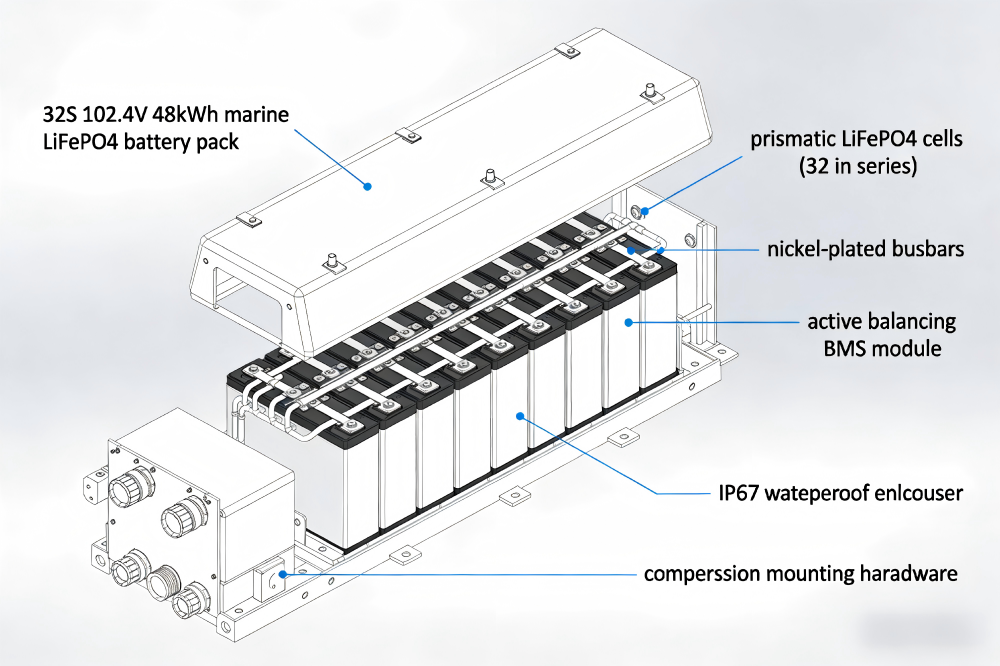
The biggest hurdle in any electric sailboat conversion? Engineering a marine-grade battery system that delivers sufficient capacity, stable high voltage, and uncompromising offshore safety. In this guide, we break down a real-world client retrofit, walking through how to build a robust 102.4V / 48.3kWh marine propulsion battery pack from scratch using 32 brand-new 3.2V 472Ah high-capacity LiFePO4 prismatic cells.
1. System Design & Specs: Engineering a 102.4V 48.3kWh Propulsion Battery
For this build, the client selected 32 premium Cornex 472Ah LiFePO4 cells—industry-leading units engineered for high-end energy storage systems (ESS). Configured in a 32-cell series (32S) layout, the system delivers industry-leading performance for marine electric propulsion, with core specifications:
- Nominal System Voltage: 3.2V × 32 = 102.4V
- Single-Charge Capacity: 472Ah
- Total Usable Energy Storage: ~48.33 kWh
Key Advantages of a 102.4V High-Voltage Architecture
In electric sailboat conversions, 48V and 96V/102V are the most common system voltages. A 32S 102.4V high-voltage setup delivers critical marine-specific benefits:
- Reduced Current & Heat: For a 20kW marine propulsion motor (common for mid-to-large sailboats, e.g., Oceanvolt or Torqeedo), a 102.4V system draws half the current of a 48V setup, drastically minimizing cabling heat buildup and boosting safety on long voyages.
- Lighter, Cost-Effective Cabling: Lower current allows thinner pure copper marine cables, cutting high wiring costs and reducing vessel weight—a critical factor for sailboat performance and balance.
- Optimized Motor Efficiency: Many high-power premium marine electric motors are calibrated for high-voltage input, delivering enhanced low-end torque and more responsive throttle for harbor maneuvering or rough seas.
2. Why ESS-Grade Large-Format Prismatic LiFePO4 Cells Are Ideal for Marine Use
Historically, DIY marine battery builds relied on wiring hundreds of small cylindrical cells (e.g., 18650s) in series-parallel setups—a design rife with offshore safety risks. The client’s choice of 472Ah large-format prismatic aluminum-housing cells is a game-changer for these key reasons:
- Simplified, Reliable Structure: A pure 32-cell series configuration with zero parallel connections minimizes weld and connection points, drastically reducing loose connection risks from constant vibration and wave impact at sea.
- Precision BMS Monitoring: With no parallel cell groups, a dedicated battery management system (BMS) accurately tracks voltage, internal resistance, and temperature of every individual cell, eliminating mismatched cell "barrel effect" to maximize cycle life and long-term reliability.
- Unmatched Marine Safety: LiFePO4 is widely recognized as the safest commercial lithium-ion chemistry, with exceptional thermal and chemical stability. It resists thermal runaway even in high engine room temperatures or accidental physical damage, ensuring maximum vessel and crew safety.
- Industry-Leading Cycle Life: ESS-grade 472Ah Cornex cells deliver 6,000 to 8,000 full rated cycles. For most sailing use cases, this translates to a service life matching the vessel’s own lifespan, with minimal degradation over decades of use.
3. Critical Marine-Specific Best Practices for Battery Assembly
If you’re planning a similar electric sailboat conversion, these three non-negotiable marine requirements will help you avoid costly, dangerous mistakes:
- Marine-Grade Smart BMS: 102.4V high-voltage DC systems require a purpose-built active-balancing BMS with pre-charge functionality, rated for full system voltage. Opt for a BMS with Bluetooth or NMEA 2000 communication for seamless battery status monitoring on your vessel’s chartplotter.
- Salt Spray & Corrosion Protection: Marine environments are highly corrosive from salt spray. All cell busbars must be nickel-plated, with antioxidant conductive paste applied to all bolted connections. The full battery enclosure must meet IP67 waterproof standards to block water and salt ingress.
- Robust Cell Compression & Mounting: Prismatic aluminum cells experience minor expansion during charge/discharge cycles. Use rigid epoxy insulation boards and threaded compression rods to secure the 32-cell stack firmly. This mitigates expansion-related wear and protects the pack from extreme shock and vibration in heavy seas.
Final Thoughts: Embrace Sustainable, Silent Sailing
Building a 48kWh LiFePO4 battery pack with 32x 472Ah cells delivers the long-range capacity needed for extended offshore passages, while setting the benchmark for modern marine electrification and safety.
The foundation of any successful electric sailboat conversion is sourcing reliable, high-quality, marine-suitable LiFePO4 cells. Whether you need a 12V/24V house bank for on-board amenities, or a heavy-duty 96V/102.4V system for main propulsion, we offer industry-leading LiFePO4 cells and full technical support for your retrofit project. Explore our [High-Capacity LiFePO4 Cell Catalog] today to request a custom quote for your sailing vessel.
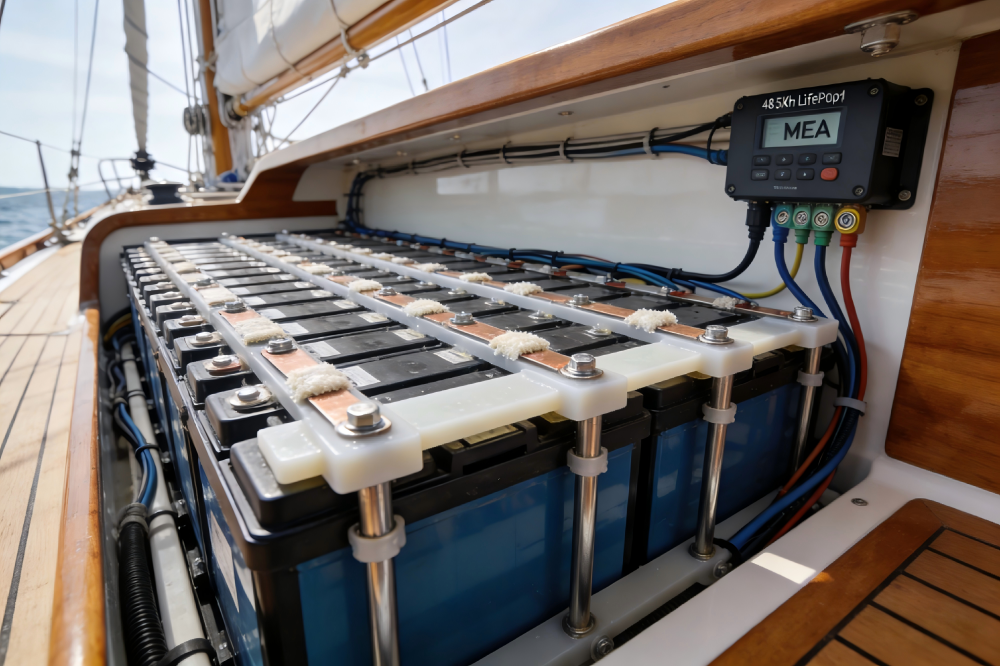
Image Generation Specifications (Western professional sailing aesthetic, low repetition, matched to article content)
1. Cover Image (16:9 wide format, for article header)
Prompt: Western marine magazine style cover, ultra-clear 8K, modern white electric sailboat gliding on calm deep blue ocean at golden hour, no diesel exhaust, clean minimalist composition. Lower half of the frame overlays bold, legible title text Zero-Emission Sailing Handbook: Build a 48kWh LiFePO4 Battery System, with a subtle 3D render of a neatly arranged 32-cell LiFePO4 battery pack in the background. Color palette: deep navy blue, matte silver, crisp white, warm golden sunlight. No cluttered elements, professional, premium, and aligned with Western sailing enthusiasts' aesthetic.
2. In-Article Image 1 (8:5 technical format, placed in Section 1 System Design)
Prompt: Clean industrial 3D technical diagram, 8K ultra-clear, exploded view of a 32S 102.4V 48kWh marine LiFePO4 battery pack. Clearly shows 32 prismatic LiFePO4 cells arranged in series, with labeled core components: nickel-plated busbars, active balancing BMS module, IP67 waterproof enclosure, and compression mounting hardware. Light gray neutral background, crisp white technical lines, English labeling, minimalist and professional, compliant with Western engineering drawing standards, easy to read for DIY sailing enthusiasts.
3. In-Article Image 2 (3:2 real-world format, placed in Section 3 Assembly Best Practices)
Prompt: Realistic high-resolution photo, 8K, close-up of a professionally installed 48kWh LiFePO4 battery pack inside a modern sailboat's engine room. Shows the 32-cell stack firmly secured with epoxy insulation boards and compression rods, nickel-plated busbars with antioxidant paste, waterproof marine-grade BMS with NMEA 2000 wiring, neatly routed marine cables. Background features warm wooden sailboat cabin structure, soft natural lighting, clean and organized installation, authentic marine environment, aligned with Western cruising sailors' practical aesthetic.
Welcome to contact us:
Inquiry more product details from the : Lithium Ion Battery Manufacturers
WhatsApp/Wechat/Mobile: +86 13332949210
Email: info@xihobattery.com
Website: www.xihobattery.com
Welcome to contact us:
Inquiry more product details from the : Lithium Ion Battery Manufacturers
WhatsApp/Wechat/Mobile: +86 13332949210
Email: info@xihobattery.com
Website: www.xihobattery.com
LiFePO4 Battery Handbook: The Industrial Energy Solution Decision-Maker’s Guide
BAK Battery Launches Industry-First Ultra-Safe Lithium Cell Lineup for China’s Imminent Mobile Power
Leave a Reply
Your email address will not be published.Required fields are marked. *