By XH-Alan | 02 April 2026 | 514 Views
NMC vs LiFePO4 Battery Chemistry: Selecting the Optimal Power Source for Mission-Critical Industrial
For mission-critical industrial test and measurement equipment — from precision medical diagnostic systems and robotics calibration platforms to industrial automation test rigs — the selection of the right lithium battery chemistry is non-negotiable. Your battery choice directly dictates equipment uptime, long-term maintenance costs, on-site operational safety, and consistent performance in even the most demanding industrial environments. Two lithium-ion chemistries dominate the industrial space: Nickel Manganese Cobalt (NMC) and Lithium Iron Phosphate (LiFePO4, or LFP), each with distinct performance tradeoffs tailored to specific industrial use cases.
Core Selection Criteria for Industrial Test Equipment Battery Systems
Unlike consumer electronics, industrial test equipment has non-negotiable performance requirements: continuous reliable operation, minimal unplanned downtime, compliance with strict industrial safety standards, and resilience to variable on-site conditions. These requirements elevate battery chemistry selection from a trivial component choice to a core operational decision, with direct impacts on both equipment performance and total cost of ownership over its full service life.
Inherent Safety Profiles: Thermal Stability & Operational Risk Mitigation
Safety is the paramount priority for industrial test equipment, where battery failure can lead to costly equipment damage, unplanned facility downtime, and even on-site safety hazards. LiFePO4’s robust olivine crystal structure delivers exceptional inherent thermal and chemical stability, with a thermal runaway threshold of ~270°C — a full 70°C higher than NMC’s layered oxide structure, which begins to degrade and release oxygen at ~200°C. This translates to a drastically lower risk of fire, thermal runaway, or explosion, even in the event of physical damage, overcharging, or short-circuiting. By contrast, NMC carries a moderate fire risk under abusive conditions, requiring more robust protective engineering for industrial deployment.
Cycle Life & Long-Term Durability for Continuous Industrial Operations
For industrial test equipment running near-continuous operations, cycle life directly correlates to replacement frequency and long-term operational costs. LiFePO4 batteries deliver a rated lifespan of 2,000 to 5,000+ full charge-discharge cycles, retaining 80% of their original capacity at the end of this cycle life. NMC batteries, by comparison, typically deliver just 1,000 to 2,000 full cycles before experiencing significant capacity fade. For 24/7 industrial test environments, this means LiFePO4 batteries can deliver 2-3x the service life of NMC alternatives, drastically reducing planned maintenance and replacement downtime.
Energy Density & Power Output Consistency for Demanding Test Scenarios
Energy density is the key differentiator for compact, portable test equipment. NMC batteries offer a significantly higher gravimetric energy density, ranging from 150 to 250 Wh/kg, compared to LiFePO4’s 90 to 120 Wh/kg. This makes NMC the preferred choice for space-constrained, handheld, or portable industrial test devices where size and weight are top priorities. However, LiFePO4 delivers far more consistent voltage output across its full discharge cycle, eliminating the voltage sag that can disrupt precision test measurements, even as the battery nears full discharge.
Total Cost of Ownership (TCO): Upfront vs. Lifetime Expenses
While NMC batteries typically carry a lower upfront purchase cost, LiFePO4 delivers superior long-term value for industrial applications. LiFePO4’s extended cycle life, minimal maintenance requirements, and lower risk of premature failure translate to a drastically lower total cost of ownership over the equipment’s service life. NMC’s more frequent replacement needs, combined with stricter maintenance and safety monitoring requirements, drive up lifetime costs significantly, even with a lower initial investment.
Environmental Resilience for Industrial Operating Conditions
Industrial test environments often expose equipment to extreme temperatures, mechanical vibration, and variable operating conditions. LiFePO4 batteries maintain stable performance and resist capacity degradation far better than NMC in these harsh settings, with a wider operating temperature window and superior resistance to vibration-induced damage. This makes them far more reliable for fixed industrial test rigs operating in manufacturing facilities, factory floors, or outdoor test environments.
Sustainability & Ethical Sourcing Considerations
LiFePO4 batteries offer a more sustainable and ethically responsible supply chain, as their chemistry contains no cobalt — a material associated with significant ecological damage and well-documented ethical concerns in global mining operations. NMC’s reliance on cobalt creates both supply chain volatility and sustainability risks, while LiFePO4’s iron-phosphate base supports more responsible, low-impact sourcing and easier end-of-life recycling.
Ideal Use Case Alignment for Each Chemistry
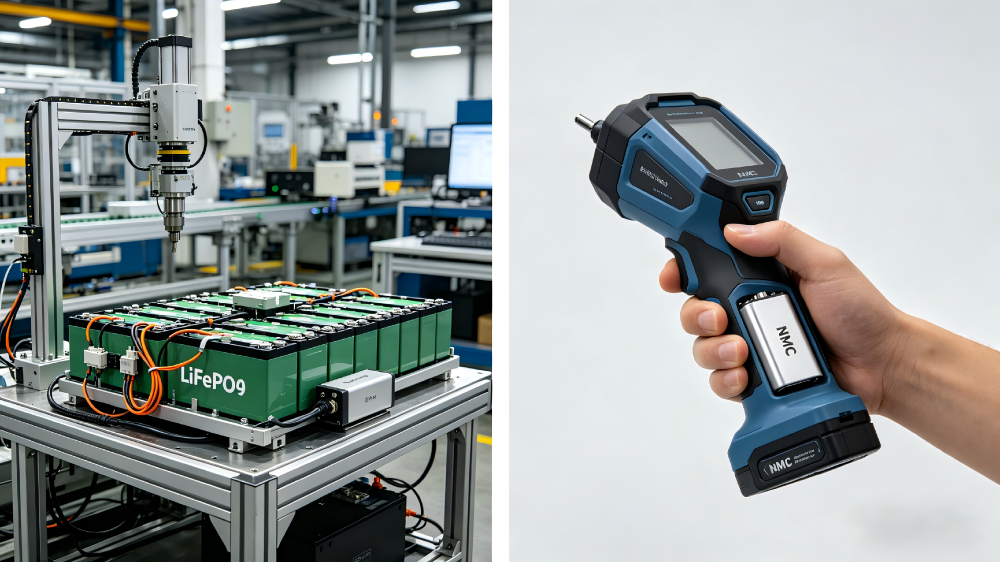
LiFePO4 is the optimal choice for fixed, high-utilization industrial test equipment, including factory automation test rigs, infrastructure monitoring systems, continuous-run calibration equipment, and any application where safety, long service life, and consistent performance are non-negotiable. NMC is best suited for compact, portable industrial test devices, including handheld diagnostic tools, mobile robotics test platforms, and battery-powered medical test equipment where size and weight are critical design constraints.
Final Recommendations for Industrial Test Equipment Power Selection
For the majority of high-demand, continuous-run industrial test equipment, LiFePO4 batteries offer an unbeatable combination of inherent safety, long service life, consistent performance, and low total cost of ownership. While NMC batteries excel in space-constrained, portable test devices, their shorter lifespan, higher safety risk, and elevated lifetime costs make them less suitable for heavy-duty, fixed industrial test applications. Ultimately, the right chemistry choice depends on aligning battery performance with the core operational priorities of your specific test equipment and use case.
Welcome to contact us:
Inquiry more product details from the : Lithium Ion Battery Manufacturers
WhatsApp/Wechat/Mobile: +86 13332949210
Email: info@xihobattery.com
Website: www.xihobattery.com
Welcome to contact us:
Inquiry more product details from the : Lithium Ion Battery Manufacturers
WhatsApp/Wechat/Mobile: +86 13332949210
Email: info@xihobattery.com
Website: www.xihobattery.com
CALB Debuts Groundbreaking Zhijiu Ultra-Long-Cycle Storage Cells & AI-Powered Zero-Carbon Ark Platfo
2026 Tianjin E-Mobility Expo: CORNEX Debuts Breakthrough LFP & Sodium-Ion Battery Tech
Leave a Reply
Your email address will not be published.Required fields are marked. *