Building a 261kWh Energy Storage System with 280Ah LiFePO4 Batteries
The global shift towards renewable energy and the need for reliable backup power have established advanced Energy Storage Systems (ESS) as a cornerstone of technological progress. Among available battery chemistries, Lithium Iron Phosphate (LiFePO4 or LFP) has become a leading choice for stationary storage due to its exceptional safety, long lifespan, and stability. This article details the configuration and benefits of a standardized 261kWh energy storage cabinet utilizing high-capacity 280Ah LiFePO4 battery cells.
Core Building Block: The 280Ah LiFePO4 Prismatic Cell
The foundation of this 261kWh system is the 280Ah LiFePO4 prismatic cell. This large-format cell offers significant advantages in energy density and ease of system integration.
•Nominal Voltage: 3.2V
•Rated Capacity: 280Ah
•Energy per Cell: 3.2V * 280Ah = 896 Wh (approximately 0.9 kWh)
System Configuration: From Cells to a 261kWh Cabinet
To create a high-voltage, high-capacity battery bank, individual cells are arranged in a series-parallel configuration within modular packs, which are then integrated into a full-scale cabinet.
1.Building a Battery Module: A common method is to first create modules by connecting cells in series. For example, connecting 16 cells in series creates a module with a voltage of 51.2V (16 * 3.2V) and a capacity of 280Ah.
Module Energy: 51.2V * 280Ah = 14,336 Wh or 14.3 kWh.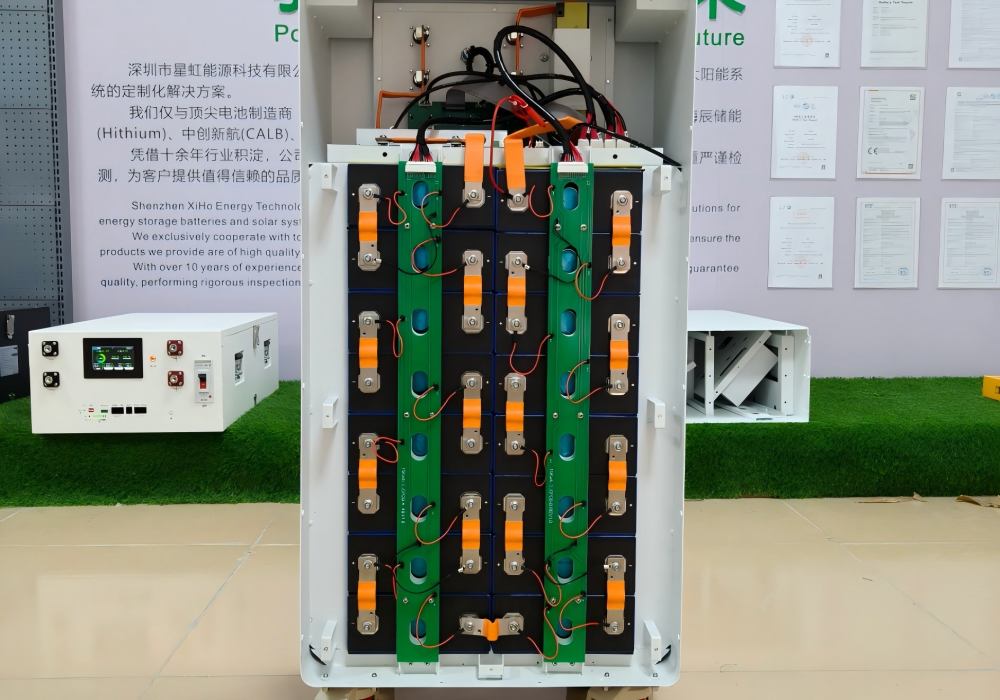
2.Assembling the Cabinet: Multiple such modules are then connected in parallel to achieve the desired total capacity. To build a ~261kWh system:
•Number of Modules: 261 kWh / 14.336 kWh ≈ 18 modules.
•Total Configuration: 18 modules in parallel (each module being 16S).
•Total System Voltage: 51.2V (Nominal)
•Total System Capacity: 280Ah * 18 = 5,040 Ah
•Total Stored Energy: 51.2V * 5,040Ah = 258,048 Wh or ~258 kWh.
Note: Commercial designs often use a higher DC bus voltage (e.g., 384V or 800V+) for greater efficiency. This is achieved by connecting more cells in series per string, while the 261kWh total capacity is maintained by adjusting the parallel configuration.
Key Features and Advantages
•Unmatched Safety: LiFePO4 chemistry is inherently stable and resistant to thermal runaway, making it far less prone to fire or explosion compared to other lithium-ion types. This is critical for commercial and industrial installations.
•Exceptional Cycle Life: These systems are engineered for longevity, typically enduring over 6,000 charge-discharge cycles while retaining 80% of original capacity. This translates to 15+ years of daily use and a low total cost of ownership.
•High Efficiency: LiFePO4 batteries offer high round-trip efficiency (95-98%), minimizing energy loss as heat during charging and discharging. This maximizes return on investment for applications like solar self-consumption.
•High Energy Density: Using 280Ah cells reduces the number of physical connections and components, resulting in a compact footprint for a large amount of stored energy.
•Minimal Maintenance: Unlike lead-acid batteries, LiFePO4 systems require virtually no maintenance, significantly reducing operational costs.
•Integrated Battery Management System (BMS): A sophisticated BMS continuously monitors cell voltage, temperature, and current. It ensures cell balancing, provides protection against overcharge/over-discharge/short circuits, and enables remote monitoring and control.
Typical Applications
•Commercial & Industrial (C&I) Peak Shaving: Reduces electricity costs by discharging stored energy during periods of high, expensive grid demand.
•Solar Energy Storage: Stores excess solar power generated during the day for use at night, increasing energy independence.
•Uninterruptible Power Supply (UPS): Provides critical backup power for factories, data centers, and commercial buildings to prevent operational downtime.
•Microgrids and Grid Support: Helps stabilize the electrical grid by providing frequency regulation and ancillary services.
•EV Charging Stations: Manages power demand and prevents costly grid upgrades by supplying high-power bursts for electric vehicle charging.
The 261kWh energy storage cabinet, built with robust 280Ah LiFePO4 cells, represents a state-of-the-art solution for modern energy storage needs. Its superior safety profile, long service life, and high efficiency make it an economically sound and reliable choice for a wide range of commercial, industrial, and utility-scale applications. As the world continues to embrace renewable energy, such standardized, high-performance battery systems will play a pivotal role in building a more resilient and sustainable energy infrastructure.
Inquiry more product details from the : Lithium Ion Battery Manufacturers
WhatsApp/Wechat/Mobile: +86 13332949210
Email: info@xihobattery.com
Website: www.xihobattery.com